Tokay GeckoGekko gecko |

Custom Search
|
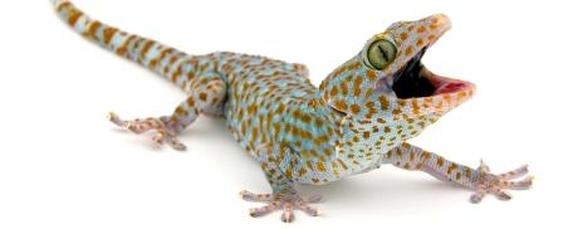
Tokay geckoes have established populations in Martinique, Belize and in the US is probably found in Hawaii and has established itself in Florida just like the invasive snakes found in Florida.
In their native habitat, they live in rainforests in the trees and cliffs, like all geckos they are great climbers. But these nocturnal arboreal geckos have also adapted to live in rural human habitations. Where they are frequently seen roaming walls and ceilings at night searching for their favorite prey, insects. These lizards belong to the genus Gekko, so they are considered true geckos. The Tokay gecko mating call is a kind of loud bark sounding similar to "To-Kay” or “Gekk-Gekk”, and is quite similar to that of the Large Forest Gecko (Gekko smithii). Those sounds are so distinct that they originated both the scientific and common name for this species. This goes even further since both the family and the generic scientific names for these lizards derived from their calls. Tokay Geckoes are considered the second largest gecko species in the world, males, in particular, are quite big. While females reach only about 7 to 19 inches long (18 - 48 cm), males grow bigger ranging anywhere between 11 and 20 inches (28 - 51 cm) in length. Their weight ranges from 5 ounces and 14 ounces (150 to 400 gm).
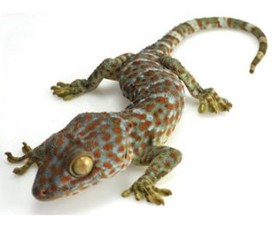
The Tokay geckoes are known for their quite unique appearance with a very attractive coloration in particular males which are more colorful than females.
Males also possess a small swelling at the base of the tail due to the presence of the 2 hemipenes. Also visible are the postanal tubercles and both femoral and preanal pores. Their skin is usually grayish or bluish in color covered with yellow, orange, brownish red or bright red spots and flecks. But in order to better blend with the surrounding environment, they can make their skin color lighter or darker. This adaptation is used to make them less noticeable to other animals, like predators or prey. Their skin is soft and granular with a kind of velvet feel to the touch. The Tokay gecko has a cylindrical and stocky body with a rather flat top and a long characteristic semi-prehensile tail. The legs are uniform in size and well defined, with their toes covered in fine setae which allow them to cling to vertical and even overhanging surfaces while moving very fast. They have a large head distinct from the neck with large prominent eyes and strong muscular jaws. The eyes are brown or greenish brown with a vertical slit and bright yellow to an orange pupil. The eyelids are transparent and fused together. Their eyes are with transparent scales that serve as protection, they are often seen licking their eyes to clean these scales. The Tokay gecko ears are those small holes located on both sides of their head. On the top of their head, these lizards display what's usually described as a rudimentary third eye.It's believed to be used to adjust their activity to the environmental light conditions. Apart from large venomous snakes, birds, and other larger reptiles found in the Asian rainforests the Tokay gecko doesn't have many predators. But these feisty geckoes aren't defenseless, they can inflict an extremely painful and damaging bite to a predator or the unfortunate human trying to handling it. They are also well camouflaged and as a last resort they will drop their tail which continues twitching for several minutes, giving them time to escape predators. They are able to regenerate their lost tail in about 3 weeks, although normally not as long as the original. While in captivity Tokay geckos can live up to 18 years, but in the wild, their average lifespan is about 7 to 10 years. Subspecies Scientists recognize 2 subspecies: G. g. gecko (Linnaeus, 1758) - Found from northeastern India to eastern Indonesia. G. g. azhari (Mertens, 1955) - This subspecies is only found in Bangladesh. Diet / Feeding The Tokay gecko eats mostly insects it's considered an insectivorous species. They feed on crickets, locusts, cockroaches, centipedes and even venomous scorpions. But occasionally they may feed on smaller geckos even those of their own kind (cannibalism) or very small mammals. These geckos have quite a powerful bite which they use to bite through the exoskeletons of insects. Reproduction The Tokay gecko is a solitary animal and they are only seen together in the mating season. The breeding season starts in the spring when daylight hours begin to increase and it lasts for 4 to 5 months. During this period males will mate with several females making their characteristic sound to attract them. They also release a fluid believed to help them attract females and also in copulation. Males often grasp females with their mouths during copulation. After mating with the male, the female will search for a suitable nest site to lay the eggs. During the breeding season females lay eggs about once every month. Usually, only 1 or 2 small, oval-shaped eggs are laid by the female which attaches them to tree trunks or any other suitable foundation. The eggs "stick" to almost any surface so they can’t move, and if they get stuck onto some packaging, they might end up traveling around the world! Both parents will take care of the eggs until they hatch after an incubation period of about 2 to 6 months. At birth, the hatchlings are about 2 to 3 inches long, and after being born they feed on the outer covering of their own skin. Their teeth grow shortly after birth enabling them to protect themselves, but they also display cannibalistic behaviors and will eat other baby geckos of their own species. The juvenile geckos are normally taken care of by both parents until they leave at 10 to 12 months of age. In this species, both genders become sexually mature at about one year of age. Conservation status and main threats The tokay gecko has no special status and the species has not been Evaluated for the IUCN Red List. They are also not listed in CITES, the Convention on International Trade in Endangered Species of Wild Fauna and Flora. Tokay geckos are considered a symbol of good luck and fertility in Southeast Asia believed to descend from dragons. But the species is also used in Traditional Chinese medicine which led to it being indiscriminately poached in some parts of its range. It's highly sought after in mainland China but also other parts of Asia where there's a Chinese community like Vietnam, Hong Kong, Taiwan, Singapore, Malaysia. Due to this hunting, collecting and trading they are on the fast track to become a threatened species in the Philippines. Where their trade runs basically unchecked due to the sheer number of poachers. But also the prospect of very lucrative deals as wealthy Chinese and other foreign nationals supposedly pay thousands of dollars for large specimens. An unfounded claim giving Tokay geckoes the ability to cure AIDS also had a negative impact on the species. Their natural habitat is also increasingly threatened by urbanization.
|
Scientific classification
Kingdom: Animalia Phylum: Chordata Class: Reptilia Order: Squamata Family: Gekkonidae Genus: Gekko Species: G. gecko Subspecies: G. gecko gecko G. gecko azhari 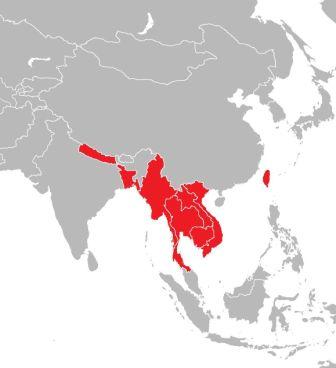
Tokay Gecko range
|
